
SMEARED into Bad Wars
Chapter Eighteen


THE MATH:
If we don’t participate by thinking it through we remain unprotected for the next assault.
+ The powerful force of the PR campaign can disconnect us from our own survival instincts and our allegiance to Natural Law.
+ Their Pattern of deception and concealment of harm leads to addiction, disease and death.
+ We must understand and memorize Their Playbook.
+ We must use the wisdom gained from past mistakes.
+ Cognitive dissonance has led to errors in our reasoning.
+ We must defend ourselves against those we thought were defending us.
+ Until we disable the corrupt revolving door we have an active breach in our defense.
+ Our over-reliance on external systems undermines our ability to defend ourselves or others.
+ The genocide in Gaza has illuminated the Pattern & Playbook for all to see.
+ The tactic of using False Claims was effective on enough of the public to get us and keep us in Bad Wars for the past 70 years and counting.
+ The tactic of using False Claims was effective on enough of the public to get us to buy and use Bad Products that cause disease and death.
+ As the Watchdogs produce truth of the falsehoods, the opposition will bury and attack this evidence.
+ Bad Companies pledges to self-regulate obstruct actual protection of public welfare.
+ Bad Companies manufacture doubt and controversy to keep us from the Truth.
+ The Captured allow evil to succeed.
+ The Captured allow disease and death to escalate.
+ The Captured allow the degradation of our land, water, and food.
In situations where great harm is inflicted on the masses—
First, they lie—Playbook tactic #1. Those producing the harm launch a campaign of FALSE CLAIMS to overwhelm and overshadow the actual truth.
Then, they assemble an army of liars—Playbook tactic #2. CAPTURED entities spread the False Claims, bury and conceal the truth of harm, and rewrite the rules so the deceivers always win and their agendas can continue.
Not all companies produce harmful products, just the Bad Companies. So, only the bad ones need to implement deceptive cover ups. The Military Industrial Complex always uses deceptive cover ups to lead us into war.
The citizenry is naturally inquisitive and concerned about all products and all foreign entanglements, but only the Bad Companies and Bad Warmongers reject that questioning and refuse any proper debate.
If any of the people get too investigative or too close to uncovering their cover ups, the Bad Companies or War Machine will implement another additional strategy to attack these people, using tactic #3—the SMEAR CAMPAIGN.
Some people “have eyes to see” the harm and others don’t. It’s not a matter of vision faculty, it’s a matter of choice. Some choose to see, others choose not to. (I believe, after a certain point, this becomes less a conscious choice and more an unconscious habit.)
Of those who see harm, some people say something, while others don’t (at lease not where anyone can hear them).
The people who see the harm and speak out about what they see range from government officials, insider whistleblowers, lawyers, activists, and journalists, to average citizens.
But once a Smear Campaign is underway—designed to ruin the credibility of those who speak, and dissuade any others from speaking—it takes a distinctly resolute type of personality to stay the course of bearing witness in spite of the attacks against them. These are our brave Watchdogs.
Bad Companies understand well that the only obstacle standing in the way of achieving all the projected success from their corrupt campaign are these individuals and groups. So the campaigners must stamp them out before they ever get a chance to gather a large audience.
Obviously, the same tactics used to support the original false claims about their bad product will be used to spread false claims about the Watchdogs.
First, they will lie. About the character of the Watchdogs, their personal history, affiliations, and alleged ulterior motives. They’ll spread rumors, distortions, half-truths, or outrageous lies—anything to create doubt about the authenticity and integrity of the truth-tellers.
The Bad Company or War Machine knows full well the kind of harm they are creating and so can easily predict where the Watchdog opposition will come from. They can launch pre-smears, or “poisoning the well”. This is where adverse information about a future target is preemptively presented to the public, with the intention of discrediting or ridiculing something that the target person is surely going to say or stand for, before they even step up to the mic.
A pejorative is a derogatory term used to express criticism or disregard. By creating a new negative term to attach to whichever watchdog is on their heels, or is forecasted to be, the Bad Company can blanket smear a whole group, which will be anyone who believes the truth of harm exposed about their products. They then create a false narrative that these people, now identified by (only by) this new repugnant descriptive, is a group that no one wants to be associated with. The subtle and invisible hand of the PR campaign, using all its tools of media control and propaganda, will suggest, everywhere, that these are people society has already deemed offensive, even if you can’t remember being offended before the campaign began. Before long, the pejorative catchphrase mantra will be embedded in the mouths of the masses, circulating on its own volition.
The entire breadth of the smear campaign will be just another false claim. Not to sell a bad product or a bad war, but to sell the public lies about the motivations of our lead defenders against those. A manufactured resistance to the actual resistance, using surrogates of captured officials and media as “message force multipliers”, to whip up genuine controversy, contempt, and fear toward the targeted faction and justify the censorship of their message.
The smear campaign utilized by the advocates of the war in Gaza illustrates for us the most common components of the strategy when trying to demonize an entire movement as a whole.
The label—using a simple, emotionally charged pejorative to characterize the group as a monolithic, dangerous entity.
Conflation— when two similar but disparate concepts are treated as the same. In order to smear, this is done intentionally, to create a false equivalence between different perspectives. Any opposition to Israel’s military actions against the Palestinian people was conflated with a threat or hatred toward all jews. The denouncement of Zionism was conflated with the denouncement of Jewish people.
The Straw Man logical fallacy— misrepresenting someone’s argument to make it easier to attack. For example, “My opponent is against all jews, but I think that’s bad”, is an easy argument to win. Opposing all jews is bad, however that is not the argument those opposing Israel’s treatment of the Palestinians were making.
The False Dilemma logical fallacy— Presenting only two options when more exist, forcing a choice between them. For example, “You either support Israel’s actions (no matter what) or you are antisemitic.” This “you’re either with us or against us” mentality severely reduces the likelihood of policy debate or any deeper, nuanced dialog.
One day after the October 7th attack by Hamas, immediate, intense protests erupted worldwide. Thousands gathered in New York City’s Times Square to show solidarity with Palestine and their right to resist the occupation.
The same day, on the Harvard University campus, more than 30 student groups issued a letter stating they held “the Israeli regime entirely responsible for all unfolding violence”. This generated significant tension on campus in the following week, and forevermore.
The smear campaign against this resistance kicked in immediately.
In the Sixties, the Vietnam War protesters were labelled deserters or commies. Those who opposed the Iraq War in the 2000s were labelled unpatriotic traitors who refused to “support the troops”. And, as we are all acutely aware, anyone criticizing the war in Gaza could be instantly labelled an antisemite or pro-Hamas domestic terrorist.
By November of 2023, students and activists were reporting harassment, even death threats. Universities utilized code-of-conduct violations to suspend students, evict them from housing, and withhold degrees. They were blacklisted and doxxed, to ruin future job opportunities. Many student protesters had active job offers revoked by employers.
The front group Accuracy in Media parked a mobile billboard truck just outside Harvard’s campus, its screens displaying the names and photos of students allegedly involved with the letter opposing the Israeli regime. Above their faces read the title, “Harvard’s leading antisemites”.
All this worked effectively, as it usually does, to make the individuals advocating for the Palestinian cause increasingly uneasy about the professional, social, and physical repercussions they could face for expressing their views.
“Any graduate students who support Palestine have to come to a decision on whether or not they’re willing to put their future career on the line before they speak up.”1
Because of the very real and very fatal antisemitism which led to the Holocaust during WWII, the western world had been deeply predisposed to take seriously any anti-Jewish sentiment since then. This anxiety had roots in society’s experiential reality, it was not abstract or invented.
A fear campaign works best when it can build upon an actual existing worry in the community. The claim of antisemitism embedded in the smear campaign against the Gaza War dissenters had its origins in a time when so many people had genuinely suffered death and heartbreak from this bigotry. The promise to “Never Forget” had no expiration date and so there has been no mechanism to determine if and when the facts or personalities of present have changed the calculus of the past. Without proper analysis of the most current intel—more importantly, the permission to even do the analysis, publicly—the more timely and accurate sentiments and viewpoints had not yet been uncovered, publicly.
Presuppositions are things tacitly assumed before an argument or course of action gets underway. These underlying assumptions are taken for granted in a statement, in order for it to make sense.
The United States-Israel relationship rests upon an extremely solid presupposition, assumed to be true with no need for discussion—that because of the long-standing "special relationship" between the two nations, the US always offers "ironclad" support to Israel.
Arguments built on presuppositions are difficult to challenge because they begin by assuming everyone agrees with the absolute truth of their core claims, placing the burden of proof on the challenger and often sealing themselves off from evidence-based critique. These arguments rely on deeply held, axiomatic beliefs that are rarely questioned during routine debate, making them behave more like foundational commands rather than propositions that need verification.
Thus, anyone who dissented from such a firmly implanted moral position—America must always protect Israel—has to make a very difficult (sounding) counter claim. They must dare to ask for reevaluation. A new perspective which asks society to consider that what was once thought of as inarguably principled may now be misguided under new circumstances is an extremely risky stance, vulnerable to attack.
Recall from our study of Bad Arguments, the Appeal to Tradition— Rather than interrogate the logic behind a certain action, the argument assumes the action is logically sound because it’s been done for a certain amount of time. The fallacy says “we’ve always done it this way.”
The challengers during 2023 were upending the presupposition of tradition held for 70 years, that the State of Israel was perpetually the victim of violence (as opposed to the producer) and so required unconditional aid to defend itself. Even though there was manifest evidence that Israel had offensively attacked multiple countries in the Middle East in recent history—including Lebanon, Syria, Iran, and of course Palestine, over and over—any call for updated reassessments could still be condemned, almost by knee-jerk reflex.
That is precisely why, when we think through it all here, we analyze using statistical logistics and prioritize the metrics of death counts, first and foremost. We cannot anymore afford to rely on antiquated traditions, unquestioned presuppositions, old or bad arguments.
Such as:
Appeals to Emotion Fallacy: a type of informal fallacy that occurs when someone attempts to manipulate the emotions of an audience to win an argument, often in the absence of factual evidence or logical reasoning. While fear or pity can be a powerful tools, it becomes a fallacy when emotional rhetoric is used instead of logic and evidence to support a claim.
The Appeal to Fear was: “If we don’t support Israel’s war unconditionally, antisemitism will injure or kill the Jews.”
The Appeal to Pity was: “You wouldn’t want to see Jewish people suffer, would you?”
The smear campaigns subsequently use those same simple and broad, yet less-logical assertions: “Those who don’t support Israel’s war will injure or kill Jews”; “Those who don’t support Israel’s war want to see Jewish people suffer”—therefore we must denounce these people.
Those of us who respect Natural Law don’t want anyone to suffer. Yet, it’s too poor a foundation for argumentation to say—this thing could cause suffering, this thing could cause harm or death, we should all be scared of this thing. We could do that all day long, for almost any thing, issue, or scenario. This is why it’s important to correspond our fear levels with the greatest actual threats, things that in actuality cause the highest death counts.
And this is why it’s important to use the most up-to-date intelligence and not more-heavily rely on wisdom of the past—building fear around this thing that once did cause harm or death. Our fear levels should match our present day reality and not any other technically non-existent or hypothetical reality.
It can seem cold and callous to reduce emotional experience down to hard numbers, but it is often the most rational way to fully examine expansive, complex situations.
The October 7th Hamas-led attack on Israel resulted in 1,195 deaths. In contrast, the Israeli offensive in Gaza has killed 72,116, with 171,798 injured (all these numbers likely an undercount2). Since October 11, 2025, the first full day of the so-called ceasefire, Israel has killed at least 631 Palestinians in Gaza and wounded 1,700.3
While over a thousand very violent Israeli deaths at the hands of Hamas is horrific in and of itself, what the critics of the war campaign countered with, immediately, were the undeniable statistics of death that proceeded the attacks on October 7th:
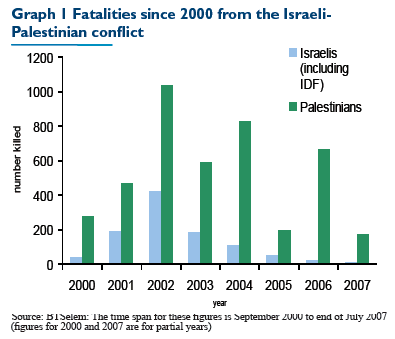
This chart comparing Palestinian and Israeli deaths goes through 2007. Another 7,428 Palestinians were killed since 2008 in the occupied territory, and over 165,000 injured. 2,464 Palestinian children were killed by Israeli forces before 2023. 87% of those were boys.4
All deaths are bad, that is mostly inarguable. The argument for supporting Israel’s two and a half year assault on Palestine was based upon the 1,195 number of deaths. This number proved the Israelis were targeted victims and justified the need for America to come to their defense.
The question on the other side of the debate has always been “where is the argument based upon the tens of thousands of Palestinians killed by Israel over the decades before the Oct. 7th attack?” It is a legitimate and logical inquiry, but it had been perpetually suppressed, up until recently.
The rejection of the PR campaign’s false claim was not arguing that “antisemitism does not exist” or that “antisemitism is not a threat”. The position was that the risk of death in allowing Israel to continue what it is doing to the Palestinian civilians is much greater than the risk of death from antisemitic sentiment growing here at home.
This is another Bad Argument in play, the False Dichotomy—the fallacy that you must choose between unconditionally supporting Israel or be an antisemite, when in reality it is possible (and also desirable) to oppose both the Israeli military’s genocidal actions and any bigoted antisemitism in our country. These positions are not mutually exclusive of each other.
If both sides of an issue are allowed to present their figures, the implicit accusation that only one side’s argument will lead to suffering of innocent people is rendered hypocritical, and the smear loses its power. We can’t do the essential benefit-risk calculations—weighing two harmful situations against each other—if we’re only given half of the factors.
In the 1960s, the Cold War fears of global communist expansion were so great that those who opposed the United States going to war against the communist North Vietnamese were smeared as commie-sympathizers. The omitted line of inquiry here was—how many American deaths had this scary communism produced?
While the “Red Scare” frightened many, if the public debate was able to weigh the death counts of Americans by communist threat versus death counts of Americans going to fight the communist threat on foreign soil in hand to hand combat, the actual latter numbers would likely have overwhelmed the fear-based hypothetical ones given in the War Machine’s false claims.
Same deal with the Iraq War. The opponents of that campaign were smeared as "supporting the enemy", all the way to the comical pejorative "freedom fries" which anyone over 40 may remember was used to denounce France's opposition to the US invasion.
Americans were not at risk of dying from the Iraqi regime. The War Machine presented fraudulent intel about potential yet non-existent weapons and made deceptive correlations to 9/11 to utilize Appeal to Fear fallacies. But anyone attempting to compare reality to fallacy with hard data could be swiftly accused of giving "aid and comfort" to our new worst enemy Saddam Hussein.
The first cleavage in the solidity of this much-used war campaign PR strategy appeared instantly after the October 7th attack two and a half years ago. At that time, it was a startling shock to the system to see Pro-Palestinian and anti-Israel protests gather organically 24 hours after the fear event. This revealed that sizable numbers in the younger generations were not basing their reasoning upon the presuppositions of their elders, in regards to our unwavering fealty to Israel. Their rationale was far more based in the logic of death count figures.
The ubiquitous smears were finally being challenged by arguments that included the devastating loss of life numbers that the Palestinians (as well as Libyans, Syrians, and Iranians for that matter) had incurred at the hands of the Israeli military. Yet, the vilification of this challenge was still in full effect.
The greater public was aware of the growing protest movement against the war in Gaza, but also very much aware of the existing danger in criticizing Israel. When truth-tellers first stepped forward, onto a battlefield where the well-known smear tactics were active, there was a discernible and detrimental lack of support from outside their group.
The imminence of the smear works to first vilify the dissenters, and secondly to create a fear of the smear in everyone else who might consider supporting the dissenters. There is an easy, instinctive way for this second group to avoid drawing any criticism onto themselves—and that is to do precisely nothing.
The March 2024 polling showed that 63 percent of Democrats say they felt the need to be extra careful when discussing the Israeli-Palestinian issue outside their home, as well as 41 percent of Republicans (who felt informed on the issue). This is nearly three times the number as those who said the same about the Russia-Ukraine war.
The tone was very much set in the environment when it came to supporting Israel, discouraging the majority of society from risking expressing any inkling of dissent, much less a very-public social media post supporting Palestinians or their advocates.
The protesters were the only concrete representation of opposition to the war in Gaza, but the majority’s silence left them hanging out to dry, where they would be extremely vulnerable to the campaigners’ strategies. President Biden was starkly silent on the issue, and Dem leaders like Chuck Schumer denounced the college protests as acts of violence.5
The attacks on the resisters then only escalated, as did the corresponding apprehension to have any association with them. By May of 2024, at least 2,000 people had been arrested at protests nationwide.
A YouGov poll that same month found that 47% of Americans opposed the college protests, and only 28% supported them.
In the hindsight of all the civilian deaths and displacement and starvation of the Palestinians since that time, we might want to feel like we agreed with the resistance in 2024. We might tell ourselves that perhaps we were too busy or too old to physically participate in any protest but our heart was anti-war. Or, if we were averse to the approach on the campuses and streets, we showed our views on the genocide in some other place, some other way.
Maybe we did voice our disapproval—outside the home— where it could be visible or audible to crucial decision-makers or fellow members of the majority. But if we did not, if our feelings of comfort or safety in doing so were jeopardized in some way, it was likely due to our fear of the smear.
We can audit our own record to investigate if the campaigners, by means of these tactics, were able to subvert our moral instincts in any way, to ultimately undermine any of our direct action. Because, I guarantee they tried to. If we can identify the points where we lost any of our self-determination, we can also scrutinize how our power was taken away, and most crucially, if any of it was given away without a proper fight.
I’ll insert a reminder that this AAR is not to guilt trip anyone about leaving our fellows out to dry, but to get better at recognizing when our true beliefs and values are at odds with our words and actions (or lack thereof). This inner conflict creates the psychologically stressful state of cognitive dissonance, which can then perpetuate the cycle of our vulnerability to more smear tactics and manipulations.
We know that the PR campaigns manufacture doubt, which breeds this dissonance, which keeps us resting, or dare we say trapped, in the grey fog of neutrality. We are not just kept neutral on an issue that may be legitimately complex, but also neutral and therefore silent and inactive toward the defamatory claims about our fellows, which we know in our heart to be false.
In the case of Gaza—Did we really believe that anyone who opposes Israel’s military action is antisemitic? Or that anyone who sides with the Palestinians is pro-Hamas? If not, was our contesting of those claims observable?
We all navigate through the same swampy waters of a smear campaign, whether or not we are the specifically-targeted pejorative group. The campaign requires our consent, not just for its assertions about the controversial war or product being promoted, but also for the lies it tells about the campaign’s opponents.
Our first line of defense against the enemy is having eyes to see the harm caused by the Bad War or Bad Product. The second line is having eyes to see the tactics in play that are trying to persuade us to aid the enemy’s offensive and turn on this first line of defense once they start speaking out about what they see.
When resistance to the War Machine or Bad Company emerges, this group will be smeared, in some fashion, by the campaigners. The success of their strategy relies on whether enough of the people will pick up the torch and burn the newly-defined antagonists at the stake, on behalf of the campaign. If the people refuse to do that, then the fire dies out and a “fair fight” can proceed. So, whenever smear campaigns are successful, at diminishing or handicapping or defeating those who dare to voice dissent, it will be because the citizenry assisted in those efforts, by (implicitly or explicitly, consciously or unconsciously) joining forces with the enemy’s agenda.
There is strength in numbers—one way or the other.
Therefore— if we have recognized the harm and understand what’s going on in The Pattern & Playbook, the next step is to give recognizable support to the side of Truth in the battle against our enemies of deception. That first line is the brave (or often just early) group of citizens who first (and ideally immediately) call out the false claims. The second line is the rest of us—will we or will we not support the defensive line?
In the early 2024 situation, 3/4 of the country was still feeling too tentative to voice their views on the Israeli-Palestinian conflict in public, and only a quarter of the population supported the protesters who were vocally in opposition. It would be one thing to keep silent as the watchdogs took the mantle of resistance if you were for the war in Gaza. But staying silent while the watchdogs held the defensive ground against something we also opposed, is something else.
The people can actively aid and abet the PR campaign by repeating the pejorative mantras to advance the spread of the smear. And/or they can passively aid and abet it by ignoring the group who is fighting back.
Where we stand now, in our journey cycling through the Pattern & Playbook, is the new Iran War campaign. And here, we can examine where we the people are diverging from our pattern.
The latest YouGov poll shows more Americans disapprove of U.S. military action in Iran (48%) than approve of it (37%).6 These sentiments are very distinct from the start of previous wars which began with high public support. In 2003, 76% of Americans approved of the decision to go to war in Iraq; 92% of Americans approved of military action in Afghanistan; 97% of Americans supported the U.S. entering World War II.
I will posit that the recent defanging of the go-to smear campaigns has a lot to do with this unprecedented and sustained disapproval. At this point in the pattern, the smear tactics would now be launching against the dissenters of this new war. But, all of the pejorative options—antisemite, commie, un-American, or traitor—are on their last legs. The public has finally recognized this element of the War Machine’s weaponry and grown a thicker skin to protect itself from the slurs and their damage.
The proponents of this new military action are of course using the same (verbatim) bad argumentation, illogical number-crunching, and false claims to sell the war. America is not at risk from Iran’s potential yet non-existent nuclear weapons, nor is Israel. The ground troops that may likely be sent to the foreign soil to protect us from the non-existent threat will unfortunately rack up the death count numbers to far exceed the hypotheticals. And these are clearly the metrics that the majority are now using to calculate their opinions and consent. Just 7% of Americans approve sending in ground troops.
Just a few years ago, these exact lies and Playbook tactics worked to get a majority to approve of and consent to support and fund the war in Gaza. Now, these tricks are no longer working. The antisemitism smear campaign, highly-effective up until now, is no longer working. Those changes in the Pattern are coming from US, not Them.
At this stage, these improvements in our defense are not resulting in less war or less toxic products. The results are the dismantling of our internal system—less denial, less apathy, less hopium delusion, and most importantly less reliance on our leadership to tell us what is true or what is good for us. This advancement is commendable and vital to our future well-being.
Their system carries on unaltered. They do whatever they want to increase profits to the elite class, and they care nothing for what the people want, which is peace, and to be safe and healthy at home. For as crazy and as bad as things look and feel right now, we can at least acknowledge there is more awareness and verification about our leadership’s lack of concern for us, despite whatever they’ve promised. In the fifth week of this war, what exactly has Congress done to effect this situation which 60% of the country is opposed to, as thousands more American soldiers are on their way to extreme danger in battle? What vote, veto, law, authorization, or limitation—have we seen?
The Constitution vests the power of declaring war with Congress; therefore no offensive expedition of importance can be undertaken until after they have deliberated upon the subject, and authorized such a measure. —George Washington, 1793
Whatever “good arguments” may be used for why the people’s will amounts to nothing since their representatives cannot act on their behalf, their inactions will speak louder than those words. We see with our eyes the actual reality, the actual truth. And this Truth is what each of us must defend and protect—inside ourselves.
We battle against any methodology or warfare that attempts to separate us from our true perceptions, beliefs, and values. We battle against our own internal mechanisms—the excuses, rationalizations, justifications, fallacies, self-deception and apathy— forged over time by living through the Pattern & Playbook our entire lives, to overcome the resultant cognitive dissonance and become better equipped to enlist in the real war, between Truth and Lies. We don’t yet have the defenses to stop the Military Industrial Complex from warring on foreign lands. We do, always, have the defenses to stop it from making us deceive ourselves about any part of it.
If we can shield and preserve what we know in our hearts to be true, we can avoid getting tricked into believing the lies of a smear campaign and shunning the resistance we should instead be supporting.

This is one of the best exhibitions of reason that I have seen on this or any other platform and that commands respect.