
Sleight of Hand
Chapter Twenty


THE MATH:
If we don’t participate by thinking it through we remain unprotected for the next assault.
+ The powerful force of the PR campaign can disconnect us from our own survival instincts and our allegiance to Natural Law.
+ Their Pattern of deception and concealment of harm leads to addiction, disease and death.
+ We must understand and memorize Their Playbook.
+ We must use the wisdom gained from past mistakes.
+ Cognitive dissonance has led to errors in our reasoning.
+ We must defend ourselves against those we thought were defending us.
+ Until we disable the corrupt revolving door we have an active breach in our defense.
+ Our over-reliance on external systems undermines our ability to defend ourselves or others.
+ The genocide in Gaza has illuminated the Pattern & Playbook for all to see.
+ The tactic of using False Claims was effective on enough of the public to get us and keep us in Bad Wars for the past 70 years and counting.
+ The tactic of using False Claims was effective on enough of the public to get us to buy and use Bad Products that cause disease and death.
+ As the Watchdogs produce truth of the falsehoods, the opposition will bury and attack this evidence.
+ Bad Companies pledges to self-regulate obstruct actual protection of public welfare.
+ Bad Companies manufacture doubt and controversy to keep us from the Truth.
+ The Captured allow evil to succeed.
+ The Captured allow disease and death to escalate.
+ The Captured allow the degradation of our land, water, and food.
+ Smear Campaigns prevent us from actively opposing Bad Wars.
+ Smear Campaigns prevent us from actively opposing Bad Products.
You and I may perceive deadly toxins or harmful drugs as bad things that could kill us. But Bad Companies just see them as products—foundational revenue streams with limitless growth. The adverse effects from these products—the addiction, disease and death—are health problems for us, but they are only PR problems for the Bad Company.
If you search through Big Business-type sites there is lots of advice for how to manage a corporate crisis and “rehabilitate search & brand reputation”. This includes putting out positive content, press releases, and corporate social responsibility (CSR) stories to “outrank the negative” and “replace defensive reactions with visible operational improvements to rebuild trust”. Also suggested is utilizing experts—“PR agencies with internal crisis playbooks to weather major storms”.1
But, like the original false claims sold to us about the product decades earlier, the “improvements” will be just as false.
The Sleight of Hand tricks a Bad Company performs are considered reasonable and appropriate operations to shuffle past obstacles and “leverage existing advantages to drive growth”. It is of great importance, to our health, that we do not also misinterpret these practices as anything less dangerous than what they are—lying, cheating, and getting away with murder.
We drill down into each distinct technicality of the craft they use, not to be fanatical or fatalistic, but because the deceptive actions which directly affect us are all very specific and technical. A general awareness of “corporate corruption” doesn’t give us a precise enough protection.
In war, analysis of the enemy’s military strategies is this specific and technical. But as long as we perceive the Bad Company as something other than an enemy we are at war with, their commercial operations often dissipate into the environment of our everyday life and we don’t combat them in a decisive, clear cut manner.
The current war against Iran has shown us all that the deeper the understanding of the enemy’s offensive game plan, the more exacting the defensive strategies can be.
Iran has spent the last 25 years watching the American way of war in its neighborhood. It watched U.S. campaigns in Iraq, Afghanistan, Libya, and Syria. It watched how the American military built up majestic, lightly defended bases across the region. It watched how American power likes to open wars: blind the enemy, wreck command-and-control, suppress air defenses, kill senior leadership, and fracture state control. Any competent adversary would have learned from this American way of war. Iran did. It would have been foolish for Tehran not to build a military system designed to withstand exactly that kind of opening blow.2
Key action = they watched. Eyes open. They paid keen attention to every detail of the US military’s schemes, weaponry, stockpiles and capacities. They studied American offensive patterns. These weren’t difficult to see, because it was the same moves over and over. Recognizing and accepting those, they developed countermoves. And every Iranian military countermove thus far has worked, to vanquish and humiliate two of the most powerful, nuclear-armed militaries in the world.
Iran even countered American propaganda techniques and outperformed its opponent in the public relations game as well:
Western neo-cons may be questioning why their most recent pitch for war, of which they did not bother to update one word of from the last century’s, is not working this time around to amass the essential initial consent from the American as well as greater global populace. The answer is that somebody has been studying their Playbook.
For so long, those who mastered the techniques of public relations—all the psychological warfare they learned from Bernays and the early masters—held the advantage because they held the tactical expertise. The same shift that has shrunk Legacy Media’s advantage by the democratization of the independent voices of the world wide web, may just as organically transfer what has been up until now a dominion of the whole PR game to a new generation whose full understanding of those tactics affords them not only more efficient and effective defensive strategies, but also new offensive strategies of their own, including beating the enemy at their own game.
SLEIGHT OF HAND TRICKS
In a typical shell game, watchers are challenged to follow the movement of three shells and a pea. In the games our opposition plays, there are too many shells for the naked eye to track, and the shells never stop shuffling. It’s been very difficult for the public to keep watch on moves this quick and sneaky, since most of the maneuvers are made behind closed doors.
But, like with all Bad Company stratagem, once a maneuver succeeds to dupe us, they will use it again and again, and all the industries will use the same move, and so those on watch should be able to spot the cons. Even though their bag of tricks is extensive, it is very worthwhile and constructive for us to dig through them. The advantage we have as individuals—always—is gleaning wisdom from past games to recognize the patterns of their movements, so to not be fooled by them anymore ourselves.
“WHITEWASHING” is the use of PR to create a false positive image of a company, to “clean” its reputation, usually because its so dirty in reality. There are a variety of ways industry virtue signals through advertising without being at all virtuous. There’s actually too many categories of this to list— greenwashing, bluewashing, pinkwashing, carbonwashing, sustainability washing, wokewashing, purpose washing, ethics washing, local washing, and more! All to create the impression of responsibility without the actual evidence of any net-positive result for the world and to hide the company’s true net-negative environmental and societal impact.
While this scam is probably the easiest for people to recognize, there are some sweeping expansions of this practice that are quite unbelievable to behold.
A few years ago, the CEO of Philip Morris International called for a ban on cigarettes within a decade. This noble sacrifice, which would outlaw its own Marlboro brand, was part of the company’s new vision to “see the world without cigarettes”. And even urging “the sooner it happens, the better it is for everyone.” Total corporate redemption—that’s a powerwash!
I know few would be quick to put faith in Big Tobacco’s amazing transformation, that a company whose products kills 8 million of its customers a year will miraculously now begin to make the world better for everyone. But there are still many Sleight of Hand features that appear in the wake of this scheme for us to unpack and learn from.
The “NEWER/SAFER” ploy is when the industry introduces another product, an allegedly “safer” version, which is not at all safe and creates another problem. The claim all rests on that added “R” which means it just has to kill slightly less than their original deadlieR product. Even if that could be considered a benefit, it’s rarely even ever true.
Unlike an amazing magician or sleight of hand artist, the moves Bad Companies make wouldn’t fool a child, but somehow they work to hoodwink our regulatory bodies and by extension the public.
The amazing artistry from Big Tobacco was waving a magick wand to turn a cigarette into an e-cigarettes and then voilá—it is now a treatment option. The false claim that the new products could help people quit smoking original cigarettes had no evidence to support it, as studies comparing the use of electronic cigarettes, placebos, and nicotine patches demonstrated no significant differences in abstinence rates. In reality, teens who vape are more likely to begin smoking cigarettes and many young people who use e-cigarettes also smoke cigarettes.
But because the FDA believed the magick, or was part of the magick, e-cigarettes were marketed to consumers as cessation or harm-reduction tools and therefore fell outside the purview of FDA’s authority to regulate the products. This fabricated illusion allowed the tobacco industry to dodge all the stringent marketing and packaging regulations for a full decade while they manifested their new base of replacement smokers.
As the less-magical reality—the deaths and disease and addiction—creeps in to break the spell, the wand is brought out again and again to transform bad to good.
Cue the latest Philip Morris International product—IQOS, which stands for “I quit original smoking”. Cue the new whitewashing slogan— “The future is smoke-free!” Because, you see, the company’s new investment is in heated tobacco products. Heat is different than smoke! Now (don’t) watch closely….cigarettes burn tobacco and nicotine, and that has severely negative health effects. But vapes don’t burn tobacco, they burn e-juice and nicotine and that has severely negative health effects. But IQOS don’t burn e-juice and nicotine, they heat tobacco and nicotine and this is going to be safe, without negative health effects.
Will this latest version of nicotine delivery prove safe, or even safeR, this time?
The FDA has taken the magick wand to create a brand new illusion. In July of 2020, the regulators authorized IQOS as a “Modified Risk Tobacco Product”, which is defined as a product which lowers individual risk and benefits the overall public health. So, according to our official protectors, this new tobacco product—the nicotine heat stick—benefits our overall health. Why should we be skeptical of their stance?
“Smokeless cigarettes not as harmless as claimed, study says”
The cancer-causing chemicals released from IQOS are the same as those in cigarettes3. Researchers did find one difference though—because the battery-charged devices time out, users speed up their ‘puff rate’ and end up inhaling more nicotine4.
The reality pitted against the illusion are reports that IQOS exposure causes cell damage, lung disease, induces oxidative stress, triggers unexpected organ toxicity, and significantly increases platelet thrombus (clot) formation, increasing the risk of atherosclerosis.56
Here the FDA uses its own brand of word wizardry. They allow the products to come to market while they disclose, somewhere behind the curtain, that: “IQOS cannot be endorsed or promoted as “safe” or “FDA approved.”
The smoke-free segment of Philip Morris International generated sales of $17 billion this year, up over 24% from just last year7. It’s booming. PMI boasts about the 43 million+ legal‑age consumers who have chosen their latest offering. Sales of their smoke-free products is now their “main growth driver”, representing 43% of the company's total gross profit, with IQOS revenues far surpassing those of their cigarette brand Marlboro8. Well done again, Big T! Keep on growing!
Of course, these winning games are played by all Bad Companies.
When Dupont was finally pressured by enough legal action from a perpetually-poisoned public, the Bad Company “voluntarily phased out” the forever chemical PFOA from the market (after 80 years of claiming it was safe, after the chemicals made it into the blood of 97- 99% of the U.S. population and 90% of its drinking water910).
In 2009, the industry voluntarily phased in their “newer/safeR” replacement product, a next-generation chemical called GenX. This product is also composed of toxic fluorochemicals, but the chemical structure is slightly different than that of the toxic fluorochemicals in PFOA. GenX is used in all the same products as PFOA— food packaging, paints, cleaning products, non-stick coatings, outdoor fabrics and firefighting foam, including in the food wrapping from 27 different fast food chains. GenX was approved for market by the EPA without adequate safety testing.
Between April 2006 and 2013, DuPont filed 16 reports of “substantial risk of injury to health or the environment” about its new chemical and submitted them to the EPA. They cite numerous health effects in animals including reproductive problems and cancer. All the same adverse effects we got with PFOA.11
In 2016, environmental research showed that GenX is more challenging to remove from water than PFOA. In 2021, the EPA deems two GenX chemicals more toxic than the PFOA they replaced. The agency finds that GenX is associated with harmful effects—in humans. In the kidney, blood, immune system, liver, and it is linked to reproductive problems, abnormal thyroid conditions, pre-eclampsia, low birth weight, high cholesterol, and kidney and testicular cancers.1213
What did the EPA do when it found out the replacement was even more dangerous for humans and the environment? Did it remove GenX from the market or the environment? No, silly, we are just beginning the saga with this one, don’t get ahead of yourself! Rather than banning the compound, the agency actually reversed course a few weeks ago and moved to rescind legally enforceable national drinking water limits for GenX and several other forever chemicals.14
Biopharmaceutical company Merck’s reputation was (temporarily) destroyed due to the Vioxx scandal in 2004, when it was revealed its drug doubled the risk of heart attack, the company buried this information and kept the product on the market for years, causing thousands of heart attacks and deaths. Patients were immediately transitioned to similar drug Bextra made by Pfizer, until it was soon discovered this drug had even greater risk of heart attack plus was linked to a severe and potentially fatal skin condition called Stevens-Johnson Syndrome (where the user’s skin falls off).15 Pfizer was even sued by its own shareholders for this because "through its own fraudulent conduct, Pfizer concealed the same information as its predecessors." In this case, the crafty shuffling is not to a newer product, just another different company’s product, that is also not safe. After Bextra was forced off market, patients transitioned to another Pfizer drug Celebrex, which is currently available but with a black box warning and the company is not allowed to advertise it to the public.
On the Big Agriculture side of the game board, Bayer-Monsanto also played the Newer/Safer whitewash trick with glyphosate. In 2023, Bayer pledged to remove glyphosate from Roundup products sold to U.S. consumers (for home use only). The Bad Company replaced glyphosate with combinations of four chemicals, two of which are banned in the European Union. The new Roundup formulations are 45 times more toxic to human health, on average. They also pose significantly greater risks to the environment. And, it has been found that original glyphosate is still being detected in American Roundup products.
Because the Big Ag giants needs to keep the American consumer in the dark about what they are buying (or they might not buy it), the industry has long fought the labeling of its GMO products, playing a game of hide-and-seek with the public. In 2016, the Obama Administration passed a law that required USDA to label foods that are bioengineered, as is done in 60 other countries. But the regulatory agency created a '“LOOPHOLE” by declaring that genetically modified material that wasn’t “detectable” didn’t have to be disclosed. This sleight of hand was a big favor to the manufacturers who through their processing could easily render such ingredients “undetectable” in the final product. The loophole was pretty significant as the exemption affects ingredients like corn and soy oils, which make up 70% of all GMO food products in the grocery stores.
USDA also created another subterfuge for the Bad Companies by allowing them to use QR codes instead of the clear written words “GMO” or “bioengineered” anywhere on the product. The customer would have to use their phone to scan every piece of food in order to seek the truth that the agency was lawfully required to provide them.
A recent victory of note is that a Federal Court this year overturned USDA’s word wizardly loophole. The judge’s opinion explained the crafty trick, “There is an obvious and important difference between whether a substance is actually present and whether, using a particular method, one is able to detect that the substance is present.” The court also ruled that the QR code-only disclosure ruse is unlawful. And now the branch of government in place to oversee food safety is again asked to enforce the food safety law they were supposed to enforce 10 years ago.
The government agencies work sleight of hand-in-hand with the corporations to develop new opportunities for trickery. One arena to keep our watchful eyes on is “biosimilars.” These are biologics that the FDA considers “highly similar to and [with] no clinically meaningful differences from an existing FDA-approved reference product.” As such, they are eligible for an “abbreviated licensure pathway.” As such, “FDA may approve a biosimilar for indications or populations without direct clinical studies in those indications or populations if the manufacturer provides adequate scientific justification”. I’m not saying I have evidence of harm from an untested biologic product, I’m just saying the loophole looks like an excellent way to shuffle past watchful eyes if there ever is any.
A key method of manipulation used to deceive the public into thinking something is actually safer or better is to focus on relative rather than absolute risk. If we were (able) to ask—does this new product pose a risk of harm? The answer is—absolutely. But often, the only question asked is—does this product pose slightly less risk, or even just a different risk, than the previous harmful product.
Philip Morris could not provide evidence that switching to IQOS reduces any risk of disease or harm compared to continuing to smoke cigarettes, because there is no evidence. But that was never their intended endpoint. Instead of the unachievable reduced risk, they went for reduced exposure. But who cares about reduced exposure, reduced anything, if it doesn’t reduce risk of harm? The new device emits lower levels of some toxicants, but that is a worthless endpoint considering it increases exposure to up to 80 others, many of which are cancer-causing. Yet, the irrelevant distinction was enough to grant them authorization and the highly-sought after “Modified Risk” label.
The weary-eyed people struggling to keep watch on the endless shuffling of shells will likely never fully understand this deceptive labelling, they will just be misled by the illusion of less-risk. The legal extended label for the nicotine heat stick is “Modified Risk Tobacco Product for reduced exposure” which masterfully mixes up the real meaning—that consumer risk has only been modified by reducing exposure to a few toxicants, but not all, and the risk for addiction and disease are in no way modified or reduced.
Can you imagine your local fire department using game like this? Because a wildfire produces less exposure to certain toxicants than an electrical fire, they don’t bother to protect any houses or people from wildfires because they produce less smoke and “less exposure” compared to electrical fires. Non-sense.
After the truth about a bad product or corporate misconduct finally comes to enough light, there is often a big scale public relations “REBRANDING” campaign. Bad products jump from company to company, companies jump from industry to industry, names change for products and companies, all to keep the public and watchdogs playing an endless game of whack-a-mole. The results of this game are that Bad Companies never lose a day of momentum or profit, and the American population gets sicker and sicker and lives an average of 2500 less days than it used to a generation ago.
Once a company does so much damage that their reputation is shot, they often create a spin-off company so that can continue the dirty work under an untainted new name.
In 2015, Dupont created a spin off company with the new name Chemours. Then Chemours introduced the PFOA replacement, the new also-toxic GenX product. And then they polluted the waters and poisoned the people, and have now been sued thousands of times over the environmental release of forever chemicals.
Here’s one of many representational examples of the merger name-change switcheroo that keeps the average citizen’s head spinning trying to track the lineage of bad corporate DNA.
American Home Products (AHP) was a massive American conglomerate and one of the largest pharmaceutical and consumer goods corporations in the United States since the 1920s. The company was widely known for its “anonymous” operational strategy, as it owned an expansive portfolio of household-name brands (Advil, Preparation H, Robitussin, Chapstick, Woolite, Chef Boyardee…) but the corporate name was kept off its product labels.
In the late 90s, the company’s popular diet cocktail drug Fen-Phen, used by over 6 million overweight Americans, was found to cause fatal heart valve damage and pulmonary hypertension. There was a massive product recall and AHP suffered billions in legal liabilities from thousands of lawsuits.
In 2002, AHP rebranded and changed its name to Wyeth, allowing the company to shed its tarnished reputation and focus on pharmaceuticals. In 2009, Pfizer acquired Wyeth, for its pipeline of vaccines and biotech products. In 2012, Nestlé foods bought the infant nutrition division from Pfizer and renamed it Wyeth Nutrition. The original corporation with the bad reputation they earned from the heart attacks is just a sedimentary substratum that most will never dig up again. The part to remember is that only the name changes. The masterminds and managers, the agenda and the strategies, live on.
The rebranding also works in reverse, where a Bad Company can acquire a company with a “good” name so to hide its degenerate business practices under a trusted household brand to reap more profits in disguise.
This is what the Tobacco giants did when sales dropped due to the tsunami of their negative PR. RJ Reynolds bought Del Monte and Nabisco, and Phillip Morris bought General Foods and Kraft. Here they could continue their craft out of the spotlight of their previous crimes. Here they could use their methods not just on the marketshare of consumers who could be convinced to smoke, but on the limitless marketshare of consumers who need to eat food. And then they degraded the food products that the people need to eat by chemically engineering them to elicit cravings—their specialty.
Here is a good overview/recap which highlights the full circle total market dominance of a company in “the flavor business”.
If an individual is found responsible for killing someone, they will go to jail and the story of their crime will follow them for the rest of their life. If a Bad Company kills lots of people with its product, the public will rarely be able to follow their crime story through all the sleight of hand mergers upon mergers. The legacy of corporate criminality behind any of our household products or drugs is long buried and usually unknown to the present-day consumer.
“BLAME SHIFTING”—the attempt to transfer the criticism or disfavor of a Bad Company or Bad product to another company, product, issue, or scapegoated individuals.
Once a Bad Company uses the spin off trick to rebrand into a different entity, they can try to toss the stink of societal damage to them, as Dupont did with Chemours in order to cleanse itself of the forever chemicals scandal.
Chemours throws DuPont under the bus, alleges company chose to discharge PFAS into the Cape Fear River
Blame is transferred, back and forth and all over, where it is scattered and confused. The locus of responsibility is now debatable, in popular opinion and in the courts. Watchdogs then have to battle on multiple fronts and the public dialog can turn to the question of which company is more to blame, which one do we go after, as opposed to how do we stop this industry from doing all this damage.
Following the federal felonies and bankruptcy of Purdue Pharma in 2019, many of the other opioid manufacturers—Endo, Allergan, Johnson & Johnson and Teva Pharmaceuticals—were put on trial in multiple states for their contributions to the epidemic. In an attempt to muddy the waters surrounding the opioid epidemic’s emergence, the drugmakers blamed everyone but themselves—“rogue doctors”, “Mexican drug cartels”, “Chinese producers”, and “dark web internet sales”.16
But their main scapegoat was of course Purdue. The mudslinging against the already-dirty company, making these other companies appear relatively cleaneR in comparison, was the heart of their defense. This is referred to as the “empty chair strategy”—‘We’re not to blame, they are!'” And the strategy was successful for the opioid manufacturers to win major victory in California, and in several other state lawsuits.
Like a game of Hot Potato, the accountability for the biggest crises in our country has been flung from company to company, from company to government agency, even agency to agency, and then as always, from presidential administration to administration.
The Bad Companies’ most-winning dodge is to put all the onus on the regulatory agencies, as they are the ones who approve and label their products as safe: “They said we could sell it—blame them! Yes, we made the harmful products, but they authorized them!”
Then the regulators blame the companies for not giving them all the necessary data and not volunteering the evidence of harm: “They never told us it was unsafe—blame them! Yes, we authorized the harmful products, but we didn’t technically approve them and we never officially said they were safe!”
The most recent play in this game which threatens the state of American public health is the currently ongoing U.S. Supreme Court case Monsanto v. Durnell, in which Bayer-Monsanto’s entire defensive argument relied on this clichéd blame shift tactic. They claim that because the EPA continues to rule that glyphosate is unlikely to be carcinogenic (despite thousands of state juries and court judgments finding that it is), federal law should then preempt states from requiring cancer warning labels or awarding any damages through state juries. The Monsanto attorneys’ premise was simple and repeated, “The agency has given us the green light.” If the Supreme Court sides with Monsanto-Bayer, this will close up the only avenue to justice for citizens harmed by pesticides and put the safety of all us solely in the hands of these two players—the Bad Company who poisons and their captured regulators who allow them to. A decision is expected in July.
And, in the long never-ending game with cigarette companies, the hot potato just got thrown back to their regulators, the FDA, who last month added the most egregiously corrupt shell yet for the corporations to hide under. In April 2026, the agency granted marketing authorization to four flavored vaping products (which is a reversal on policy about fruit flavors because they attract children) and shifted its enforcement guidelines to effectively allow other unauthorized, unapproved, formerly-known as illegal vapes to stay on the market while undergoing scientific review (as opposed to after).
“While these products are authorized to be sold in the United States, it does not mean these products are safe, nor are they “FDA approved.” All tobacco products are harmful and potentially addictive. Those who do not use tobacco products shouldn’t start.”
Those young kids who we know are lured in by fruity flavors should not start using, but we are going to temp them and market to them with mango and blueberry nicotine products and then hope they find their way to their favorite FDA website to receive the only barrier of protection between them and the more than 500 different toxic chemicals in the product, which is this recommendation that they shouldn’t start. “We told them not to start—blame them!”
The agency says all this policy reversal is an effort to tamp down on underage use of the tobacco products.
The head of the FDA Dr. Marty Makary and many of his staff resigned over this last straw—Trump’s going over their heads to “save the vaping industry”—and after receiving too many complaints from vaping lobbyists when they tried to shift course on this issue and block the fruit flavored devices from being authorized. They lost the battle to protect kids from blueberry cigarettes and now they’re fired or resigned.
And finally, what is probably the most dastardly maneuver of all the sleight of hand tactics, is when after a Bad Company’s product causes disease and death they then make moves into a different industry sector to capitalize on “THE BACK END” from the damage they caused.
In the late 1980s, the pharmaceutical giant Glaxo Smith Kline (GSK)’s held the best-selling prescription drug—the heartburn remedy Zantac. Decades later, independent research found that the medicine degrades over time into a carcinogen. When it was eventually pulled off the market and in 2024, GSK had to pay $2.2 billion to settle lawsuits for the drug causing cancer in over 80,000 claimants. But—rather than this enormous settlement cost halting revenue growth, GSK’s profit grew by 5% that quarter, driven by robust sales in its cancer treatments Jemperli and Zejula. It’s like betting on red and black in roulette—you can’t lose!
As we are now hyper-aware, Bayer owns all the Monsanto herbicides and pesticide products which numerous studies show increases the risk of cancer in the population who uses them1718 . The counties in America with the most pesticide use have the highest rates of cancer. The farming midwest is now considered the cancer belt. Here is a visual of cancer deaths doubling to 5 million since the introduction of the toxic products.
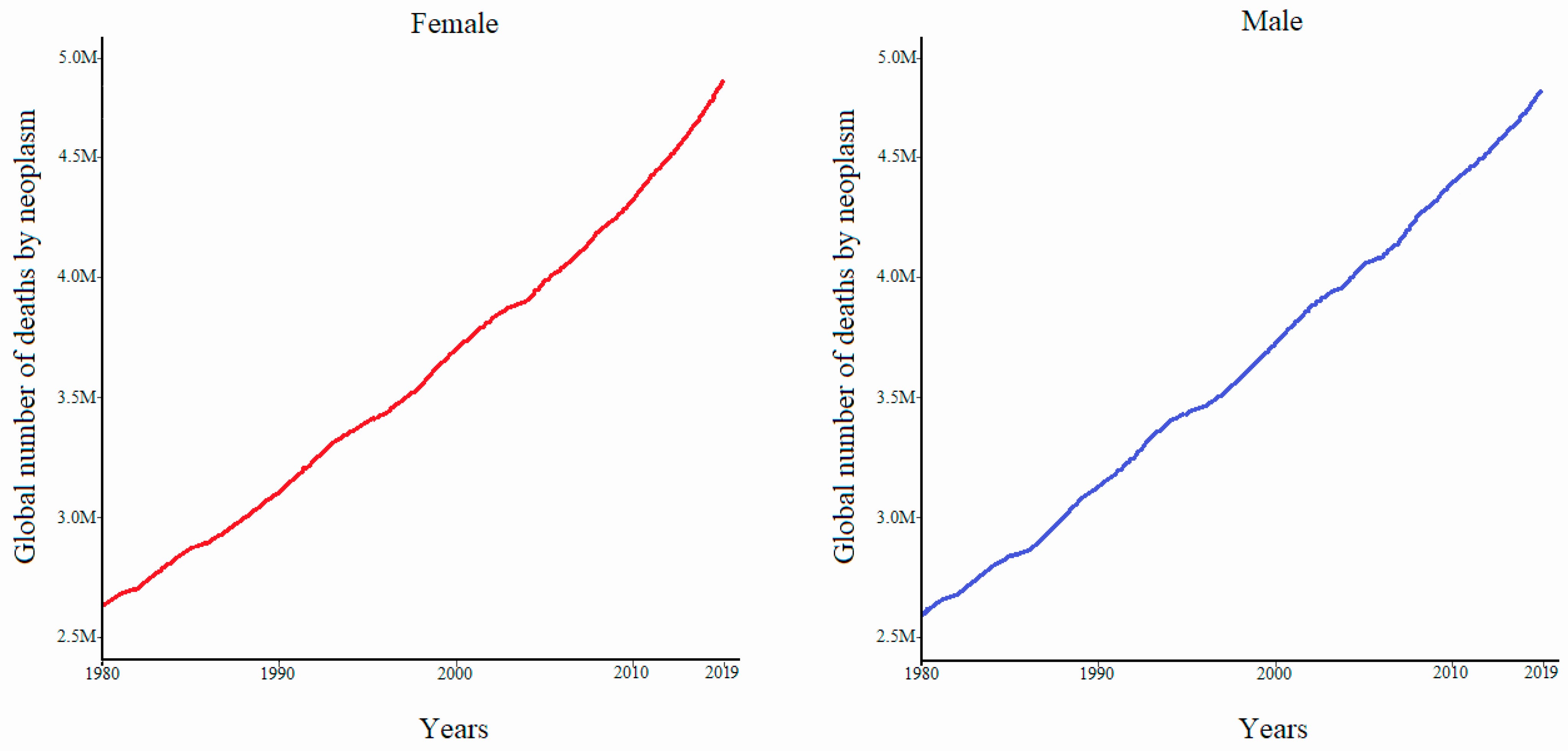
Bayer now operates across the sectors of agriculture, agrochemical, and pharmaceuticals and consumer health—as everything is everything in the hyper-consolidated corporate world.
Bayer has targeted it will pull in $10 billion in oncology therapeutic sales (cancer products) by 2030.19
In one of the cruelest ironies of modern capitalist history, Bayer is making billions treating cancer on the pharmaceutical side while simultaneously fighting tens of thousands of lawsuits on the agrochemical side from the individuals who got cancer from using or living anywhere near the use of their products.
There is no way my riff on the grotesqueness of this paradox can outdo Bayer’s own words as they hype the good news to shareholders in their Global Overview (you’ve got to read). ”With chronic diseases on the rise, the demand for healthcare and innovative solutions is growing globally.” Makes sense—huge growth in disease! Keep on growing, Bayer!
All Bad Companies either build profit at the expense of public health or benefit off the poor health of Americans. But the true psychopaths of megacorporations do both, which we can masochistically refer to as the “double dip”. They reap profit from both the cause and effect of the harm.
And once we fully accept that, it won’t be shocking to swallow the arrogance of this next example:
Purdue Pharma’s blockbuster drug Oxycontin is responsible for igniting the opioid epidemic that has killed more than 1.25 million Americans from drug overdose since 1999. In 2014, after 15 years of knowingly addicting customers, the company then brainstormed how to turn the millions of people who were now addicts into their next business opportunity, by acquiring the rights to the the opioid-reversal agents Narcan and Suboxone. Purdue executives recognized, as all Bad Businessmen would, that opioid addiction treatment was now a very “attractive market”. Purdue’s sales force could easily market these new products to the same doctors who were prescribing large amounts of opioids and had their hands full with all the addicts, who company president Richard Sackler referred to as criminals and scumbags.
Again, I cannot do justice to the actual sentiment of the marketers, but you can read it in Part III of the Minnesota Attorney General’s case against Purdue. Kathe Sackler perfectly elucidates for us this section’s tactic—the “opportunity to expand our offering as an end-to-end pain provider”. And the perfectly clear and obvious, though heinous, corporate logic—“Addiction treatment is a good fit and new natural step for Purdue”.
Too outrageous to be true, right? Here’s the StatNews headline from 2024:
FDA approves Purdue Pharma’s controversial new overdose-reversal medication
And, just to round things out perfectly, we will return to Philip Morris International and their most ludicrous reaches into the irresistible Back End of their particular harm cycle. As we’ve shown, this industry has been double-dipping for decades, with its continued sale of cigarette products around the globe while introducing vapes and IQOS unethically marketed as smoking cessation devices.
After these companies spread disease through a variety of nicotine products, and then moved into Big Food to make the population sick, obese and undernourished from their now-addictive, ultra-processed “food products”, they can now cash in on their slice of the most profitable and lucrative business sector (second only to tech)—U.S. “healthcare”.
America spends $4.9 trillion annually on healthcare and ninety percent of that goes to people with chronic health conditions, according to the CDC. 76 percent of American adults have at least one chronic condition, and more than half have two or more.20
Cue Philip Morris International’s “urgent goal” to transform itself into a wellness company! PMI states their roadmap goals on their website:
“As we work to become a company that has a net positive impact on society, we believe in the importance of continuing to invest in a future that allows us to expand our offerings to products that are suited to address unmet consumer and patient needs within the wellness and healthcare space.”
Cue the acquisitions:
Philip Morris seals deal for UK’s Vectura despite health group concerns
Vectura is a British pharmacy company that makes…wait for it…asthma inhalers!
“The market for inhaled therapeutics is large and growing rapidly, with significant opportunities to address unmet needs,” says the CEO of PMI.21 So many new open markets in the unmet needs of the chronically diseased consumer!
This tactic is best known as the Problem-Reaction-Solution model (often associated with the Hegelian dialectic). By intentionally manufacturing a crisis, a manipulator can seamlessly position themselves as the savior by offering a pre-planned solution.
Big Tobacco is aggressively moving into biotech, pharmaceuticals, and cannabis. Facing declining smoking rates, all the major companies are spending billions to secure their futures in “botanical therapeutics” and medical treatments which specifically target smoking-related illnesses. How the Bad Companies plan to introduce fruit flavors into the wellness market remains to be seen! I don’t think Big Pharma needs much help in the dependency department, but if anyone can make these drugs more addictive, it’ll be these Tobacco guys.
Similar to, similarly heinous to, in fact almost verbatim to Purdue’s rationale that addiction treatment is its next “natural step”, is Philip Morris’ motivation to make respiratory drugs its next key focus. The company says it is simply “part of a natural evolution into a broader healthcare and wellness company”.
There is nothing natural about this evolution, just like the de-evolution of Americans into a sick and weakened society is perversely, inversely unnatural.
The purpose and result of all these sleights of hand, and the frenzied tempest of deception they create, is that we eventually lose sight of the pea under the shells. The through line of criminal activity is broken and we are unable to connect what we are being offered at present to what we received in the past, to our detriment.
How many of us who know well to resist any product from Big Tobacco make no correlation to those same individuals and same strategies when freely opting for a snack from Kraft or Nabisco? How many of us mistrust pesticide manufacturers from all their bad press but never realize the medicine on our nightstand comes from the same producer?
Because the Bad Companies know that most of the public won’t pay close attention to the layers of sneaky moves beneath any particular claim, they just need to be able to say something, anything, that gives the appearance of “improvement” over the previous harmful product or behavior.
Whether whitewashing to spruce up the damage or rebranding to paint over it, there are a multitude of methods industry uses to hide their dirt under some kind of artifice. All to create for themselves another chance to profit from a fresh revenue stream. In most all of the above examples, this new stream in the back end appears to be healthcare. More specifically and technically—Biotech.
Big Pharma is biotech, Big Agrochemical is biotech. Big Tobacco is actively pivoting into biotech, as I write this.22 One monster with many arms, all shuffling shells and funneling profits in their direction. This clear and conspicuous trend across all major industry players has a name—“Pharmaceuticalisation”, Pharmaceuticalisation is the socio-technical process by which human conditions, capabilities, and behaviors are translated into opportunities for pharmaceutical intervention. For Bad Companies, this has meant shifting business practices to mirror those of pharmaceutical companies, either by acquiring pharma companies or presenting pharma-like, (“savior”-like) public image PR. For the consumer, the people, the shift is from human problem-solving toward drugs.
This latest image presented by the worst characters in our saga may look clean like a doctor’s pure white lab coat, but the image of the actual reality is what we must see clearly—the contaminated state of our environment and the degraded state of our population’s health, created by their Bad Products. They are not helping society to solve these problems, they are not improving the quality of our soil or water or food, they are not improving our health or extending our lives. They are merely shuffling shells around, all the way to the bank.
Megacorporations offering “solution products” from their pharmaceutical arms, while still profiting off of the “problem products” is an indignity equal only to the public voluntarily buying both products from the same source.
There is no newer/safer version of a Bad Company. Unless it is a bankrupted, jailed and out of business Bad Company. It is always, and only, the people who pay the ultimate price if we get tricked into into buying things from our arch enemies—those who kill the most of our fellow Americans, the ones with their sites on our family, our bodies, at this moment.
There is now full awareness of our nation’s health crisis. The people are depressed and stressed about it. This study of the opposition’s Playbook is what we need to better manage the health crisis created by the corporate crisis of incessant Bad Products.
The health and survival of our population requires more than a general knowledge of all the corruption. Until we have an intricate knowledge of every spec and schematic of the offensive strategies launched against us, we can still get outplayed.
+ The Sleight of Hand tricks prevent us from actively opposing Bad Products. =
We are all in this together! I’m not the first to say it! See you next chapter….
Actually, focus on one agency relationship and narrow your focus down to their interactions will show you a very specific picture. Luckily, almost all of it is either in the federal register, or can be FOIAed. The relationship is the one between the DEA and the FDA and who's the dog and who's the tail. Because criticism will eventually be forgotten. But their self-serving, careless, irresponsible, and sometimes outlandishly reckless actions have decimated my friends, clients I've represented, and many more. The dead cannot talk, but some of us watched our friends die and did not stand and simply cry ourselves to sleep, but kept notes, and directed questions to the agencies when they're legally required to justify their actions, and ignored the state's official line. After all, I'm not a medical doctor, but I have plenty of people in my family and friend groups are. I practiced in the exact areas of the law - criminal and admin - that's associated with the agencies, and I know how police - which the DEA basically is, entirely - operate. And the history is well documented, and I even have primary sources as no state has the capacity to truly be panopticon, and sometimes you wait 3 generations and a family find someone else fluent in Chinese looking through notebooks written in longhand a century old, kept dry by the desert heat of Nevada on land owned since the 1800s.
All drugs - hell, all chemicals we put in our bodies - have tradeoffs. Some are ones that no sane person would consider as okay. Some less so. That's not really the problem. That's how the world works. As the scientific method allowed advancements in science to go beyond mere quackery and guesswork and the placebo effect, doctors and quacks from the 1700s to, well, essentially John Snow and the cholera epidemic, were engaged in what sometimes felt like a battle of snakeoils. In fact, sometimes the snakeoil was literal, although most of the time, fearmongering needed far less work.
Medicine and quackery are not yet 100% separated. Mental health is effectively a guessing game for many patients. Individuals have differences just because of human variability. My allergies are not likely to be your allergies. I lived with someone whose COVID was entirely asymptomatic. I was not that lucky. Some drugs prescribed to me have paradoxical effects, some had no effects. The first night I was prescribed Ambien I took a long drive around Los Angeles and remembered nothing. It was the last night. I do not have such adventures on benzodiazepines. I've taken more variants than most people know exists. The Z-drug issue is so well-reported that Google Scholar runs out of room to show all the results. It's considered safe and routinely given without warning. Benzodiazepines, on their own, have LD50s so high that it's unethical to test in humans. They are scheduled by large, some on the flimiest rationales, and not even cases that has any relationship to America.
The DEA has lawyers, but they are shared in a pool with DOJ. They are prosecutors, not lifers. They are our future lawmakers, while the first day as a defense intern I was given the Dante-esque warning that this is my last chance to turn around if I wanted to go into politics. I have no regrets except my naivete that I can change anything from the inside. Turns out, funding research helps far more, preferably nonpartisan, absolutely not state-sponsored. Indiana wants to defund Kinsey? Great, Mike Pence can GTFO and I will gladly ensure that they can continue the research. I dont know the outcome - which is why I want the research to happen. I donate to research organizations because I don't know what the outcome is because why the hell am I going to pay for what already exists for free? As long as the correct question is being asked - which means one that isn't starting with a presumption or bias, which is actually far rarer than one thinks - it should be funded, and as a private individual, a donation is not in itself able to tell you anything except curiosity and importance. If the researchers aren't onboard with those, they're in the wrong line of work. I want to know about edge cases. I want to know about boundaries. I want raw data, as well as analysis, as long as its ethical. I have no power to set policy so the only thing I can pursue is information, data, and replication. But not everyone has that ability to singularly make a difference, and so individuals pool their resources so that research can be done not on a penny-by-penny basis. It's possible to do so anonymously. The IRS spent 1.6 million dollars attempting to run a sybil attack on the monero blockchain and failed. Except the traffic makes my server - that I'm renting out of pocket - more difficult to access, which violates the CFAA, and I could have logged each attempt and billed the IRS. Attempting to DDoS my servers is unlawful, but I'm not a snitch, nor am I any different from anyone not living in America. The key is they did not succeed, even though usually failure doesn't get one paid over half a million dollars just to do someone a 14 year old can do.
All that is to say, you're on the the right track, but you're one level below where the actual issue lies. Who is truly never responsible for all of the malice they can muster? Well, the executive, of course. We just spent months bombing Iran and capitulated. What consequences are to come? None. The DEA runs a multi-decade long money laundering operation on the border and takes credit for things they did not accomplish so they are a reason to exist. The law requires reporting and approval. The last time this happened was 2012. This is public, with redactions. Their OIG as well as archive.org has the PDFs. They like to redesign how their site works, so maybe archive.org is a better option.
What I don't get is why do you think you get to be the arbiter of "bad" for all of humanity. Substance use disorder has a subjective element to it. If I do heroin all day but have no money problems, supply issues, and am productive, by definition, I'm not an addict. I know plenty of people in that situation, but planes landing safely don't make the news. My great grandmother died at 94 with a bottle of grain alcohol in her arms and no regrets. I was there. Who am I to judge. My family was decimated by the Japanese invasion and she survived. I have yet to find anyone on a DNA matching site that I don't already know about who is within 3 degrees of consanguinity. I no longer drink, and I don't smoke, but if she needs it, I understand.
Purdue or any other company's opioid products are not the primary or even teriary reason for overdoses. That's not when people overdose. Tolerance protects on from that. It's the quackery of treatment that throws people into withdrawal and makes them unable to determine where their body is at, plus the inability to obtain affordable and safe supplies outside, that kills. People with tolerances can do prodigious amounts of drugs and be fine. It's hard to actually intentionally overdose oneself via injection because there's no guarantee of quality or that you will have the time to push the entire dose into you before you pass out. Acute cases happen when one is opiate naive. This is not new. It predates the Opium War. De Quincey. Coleridge. Responsible drug users can't talk because it's an admission to a crime. What's left is the official narrative. And there's no DEA antonym for abuse. Seriously. I asked.
They also do not care about patient access. Check the federal register over the rescheduling of Hydrocodone + APAP. Not their job. They're cops. Who dictate what doctors can do. The FDA rubber stamps their desires. They will never be held legally repsonsible now that Bivens is dead. They lie so often that testilying remains in use as joke and also as a descriptor. This is their UBI, their welfare state, but just for them. At our expense. The same idiots who freak out thinking skin contact to fentanyl is so dangerous that they would add a felony but not so dangerous that they are still alive to testify.
You're on the right track, but the blame is one level up. They are just very very difficult to touch. I happened to have spent years turning down higher salaries in less consequential jobs so I at least know. But in the end, we are all just Cassandra anyway.
All that, for no better reason than people who look like me and people who are white and female were having consensual intercourse in the 1880s. We can call that project a failure, at least. Although kicking my entire ethnicity out for 80 years seems... outlandishly paranoid.
Max Weber may be a bit simple in his descriptor (public choice fills in the rest), but he is, ultimately, correct.